These are the filthy words Google voice search doesn't want to hear


Google takes a decidedly more puritanical view towards "naughty" voice searches than it does toward comparable typed searches.
By default, Google blocks voice search results that it deems offensive. Presumably, its motive has less to do with keeping you from cussin' than with shielding users from questionable content in the event that Google's software misunderstands their spoken request for "pictures of shih tzus," "chicken plucking contest," or "How can I get to Bangkok?" What could possibly go wrong, you ask? Just think of Google voice search as a spoken-word equivalent of autocorrect.
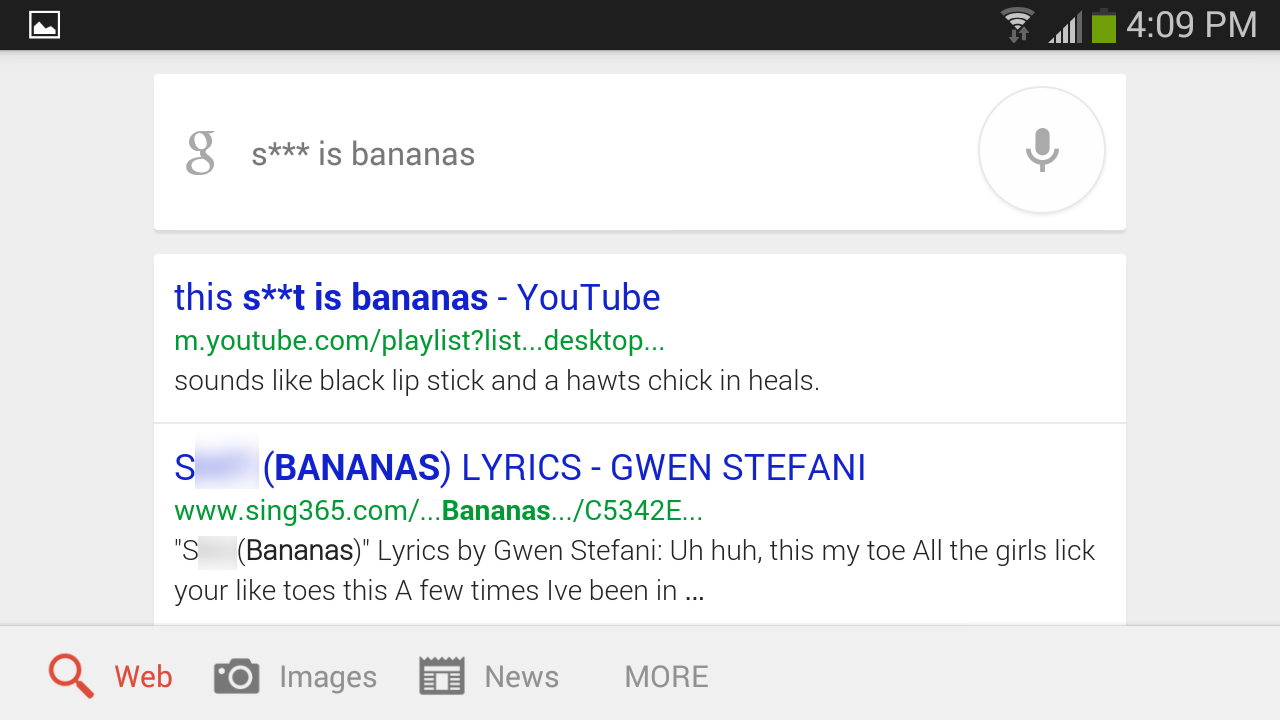
Anyway, if you vocally google the s-word, the search bar will populate with "s***" and will return a nonsense search for the letter "s," though you can usually find what you're searching for if you provide enough additional context.
s   isbanannas edit
Users can disable the software's voice search censorship in mobile search settings (though as far as I can tell, disabling it in the desktop Chrome browser is impossible), and of course there are no restrictions on inputting naughty words from a real or virtual keyboard for a standard Google search.
But in today's anything-goes, South Park culture, what words still qualify as dirty? Google has never issued an official public no-no voice recognition list, so we decided to try to create one.
In the end we were able to identify 21 words that Google voice search refuses to acknowledge. However, the company's standards for which words receives the asterisk treatment are wildly inconsistent. And some words that aren't censored are more inflammatory than some of the ones that are.
Note: The content below alludes to all manner of cuss words, sexual acts, and ethnic slurs. These terms are not part of my everyday vocabulary (in fact, I felt downright filthy after this exercise). Out of respect for our audience's sensibilities, we've tried to avoid naming or showing the actual terms, even the comparatively mild ones (but you probably won't have any trouble figuring them out). Feel free to add your own finds and opinions in the comments, but please exercise similar discretion.

The usual suspects

As mentioned earlier, the four-letter s-word gets censored. Similarly, the four-letter f-word and its conjugations are no-nos, and return search results for the letter "f" alone.
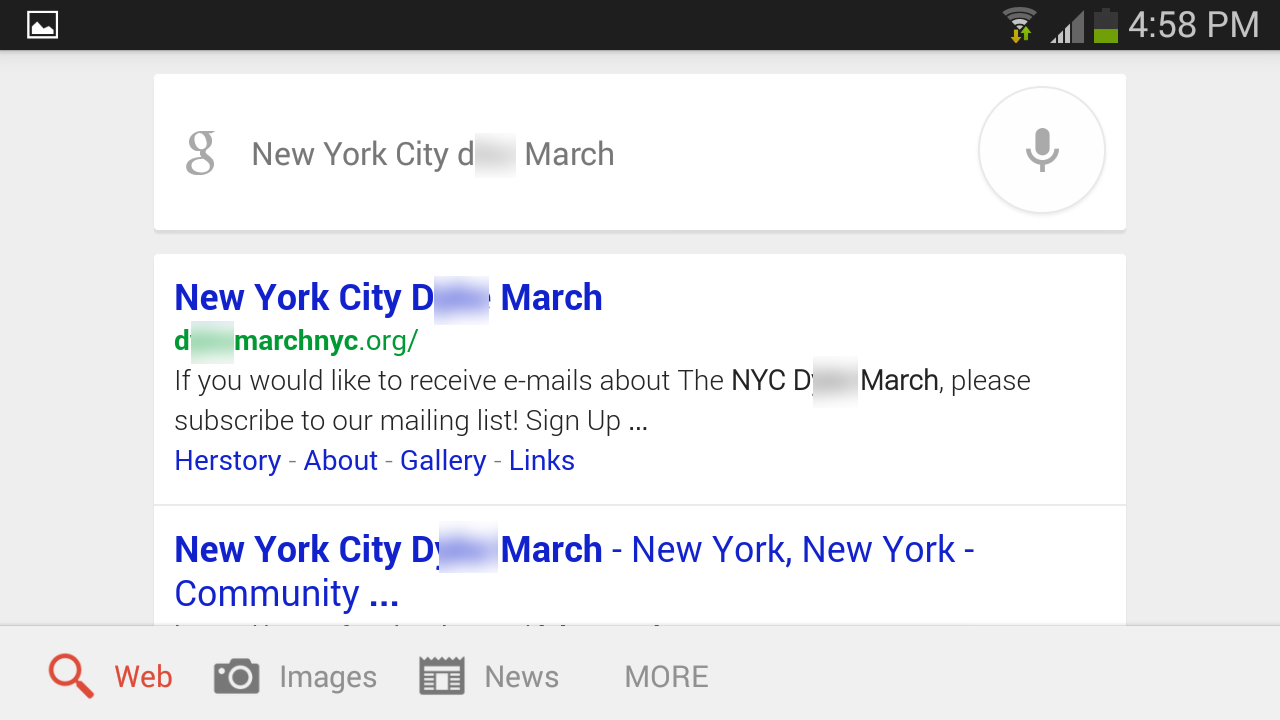
f   youyouf
The four-letter p-word for "urine" and "urinate" was one of the featured terms in George Carlin's infamous "seven dirty words" routine from 1972, but I was surprised to find this relatively mild term still being censored 42 years later.
dont piss me off
Nevertheless, you can successfully search for some forms of the word that specifically refer to being angry or annoyed. Pissy, for example, appears asterisk-free, and the search will even provide a robo-spoken definition, along with a written dictionary description that labels the term "vulgar slang."
pis y edit

Private parts

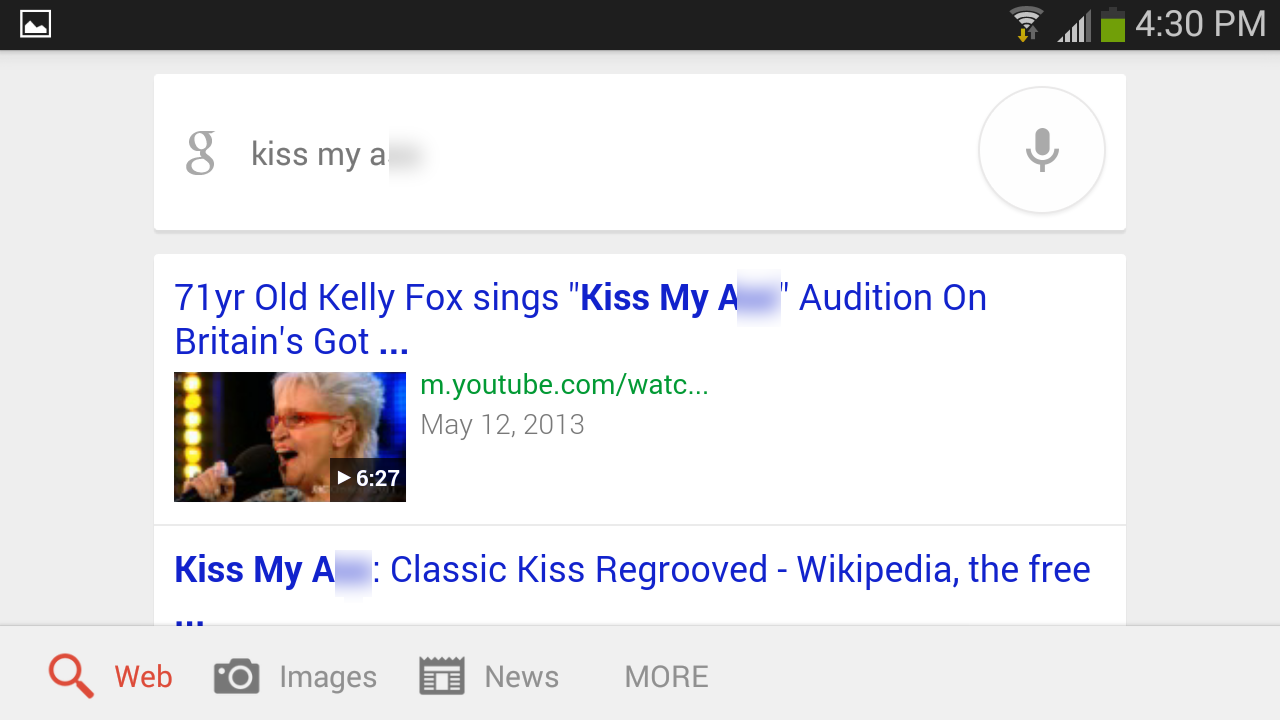
Here's a surprise: The three-letter a-word meaning "buttocks" gets a pass (maybe because it also means "donkey"?), but the b-word referring to the same body part gets blocked. Perhaps Google doesn't want to surprise users with results for butt when they want results for but, so it blocks butt altogether. It's a theory, anyway.
kiss my assedit
kissmybu
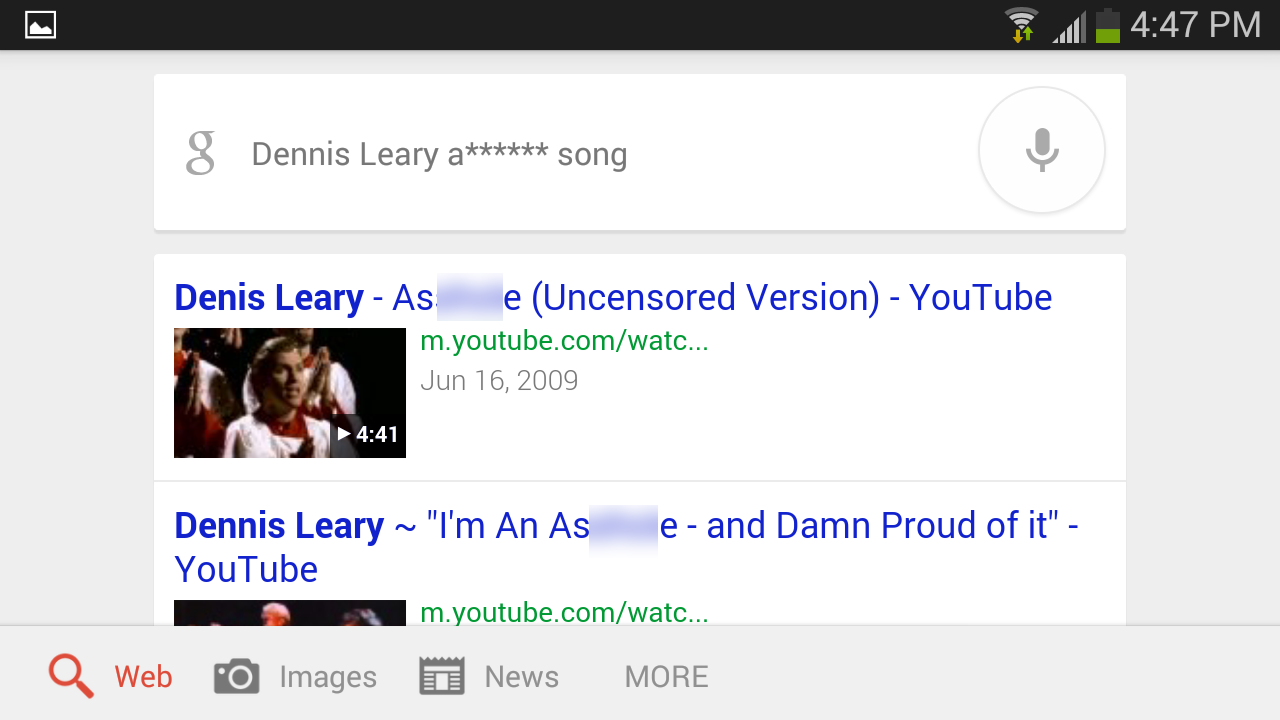
The seven-letter a-word that begins with the aforementioned three-letter a-word and has the meaning "anus" or "mean person" is censored, however.
a holedennislearyedit
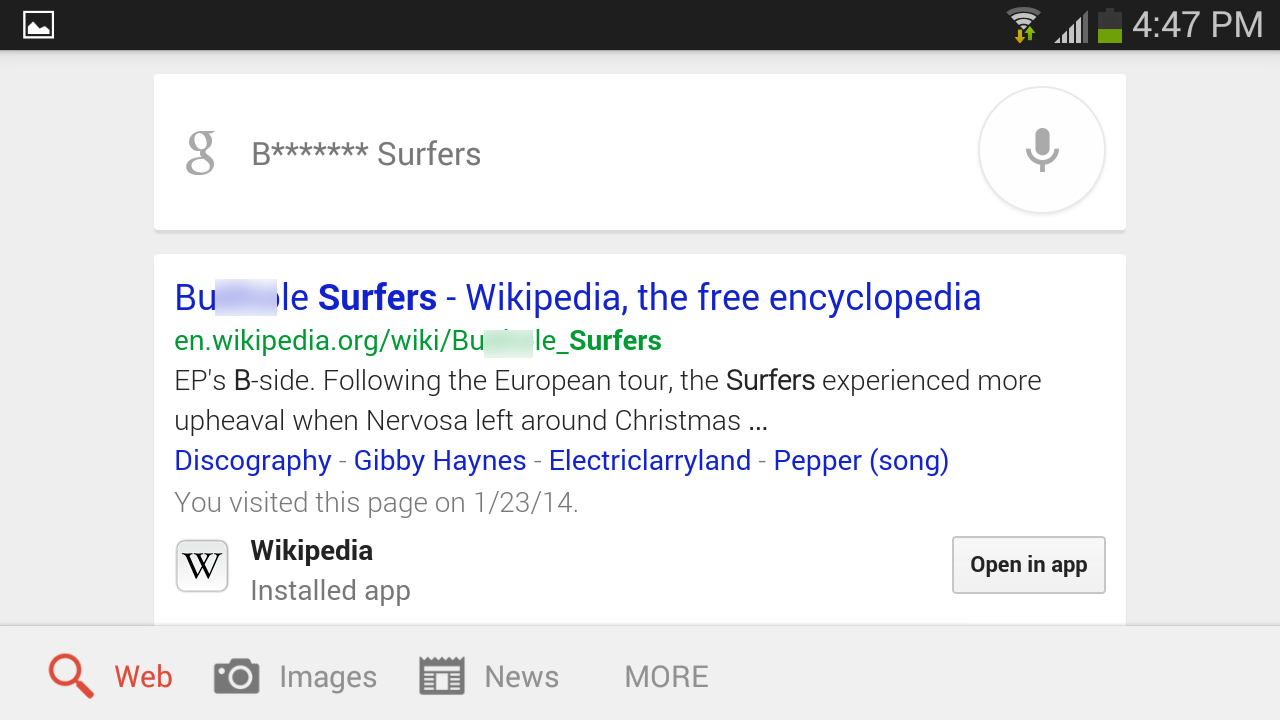
Conversely, the b-word that refers to the same orifice is also blocked, even though it easily passes basic cable muster.
bu  hole surfersedit
The plural four-letter t-word referring to female breasts (or to the Paridae, a taxonomic family of small birds that includes the various species of North American chickadees) gets covered up. But the longer version of the same word (which ends in ies and is never used to refer to small songbirds) gets through just fine.
t tsshow
titt  sshowedit
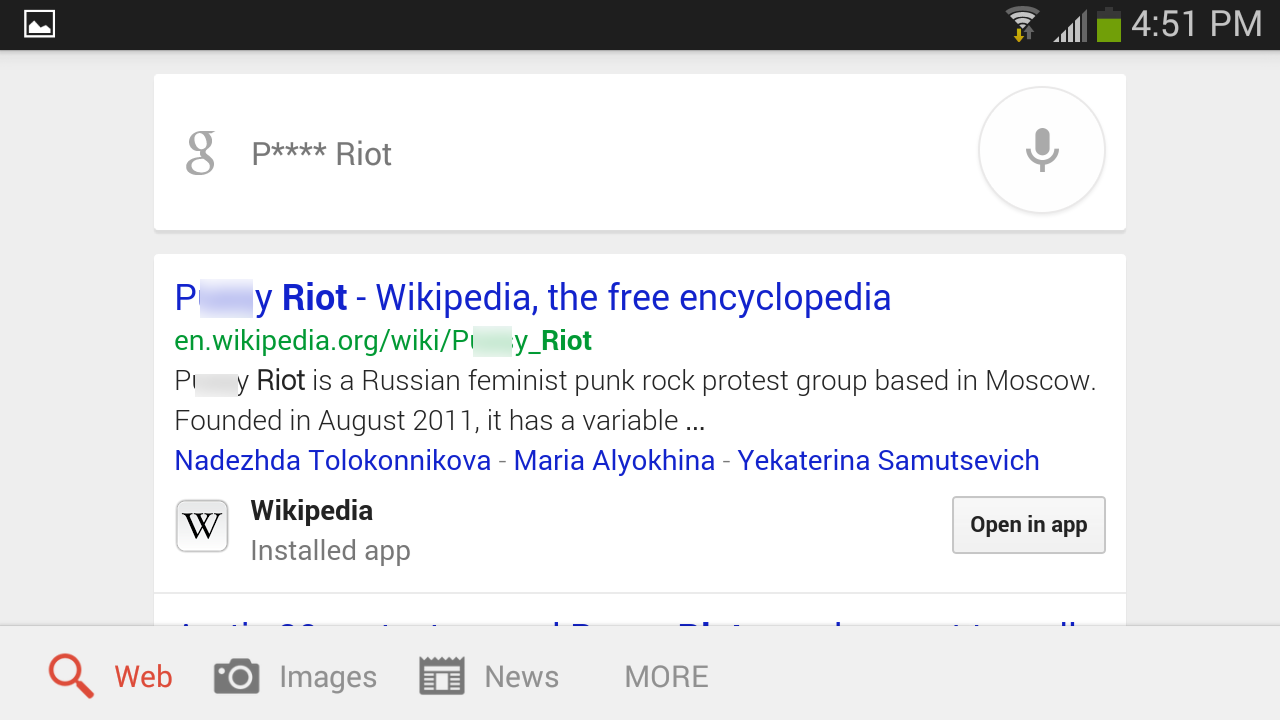
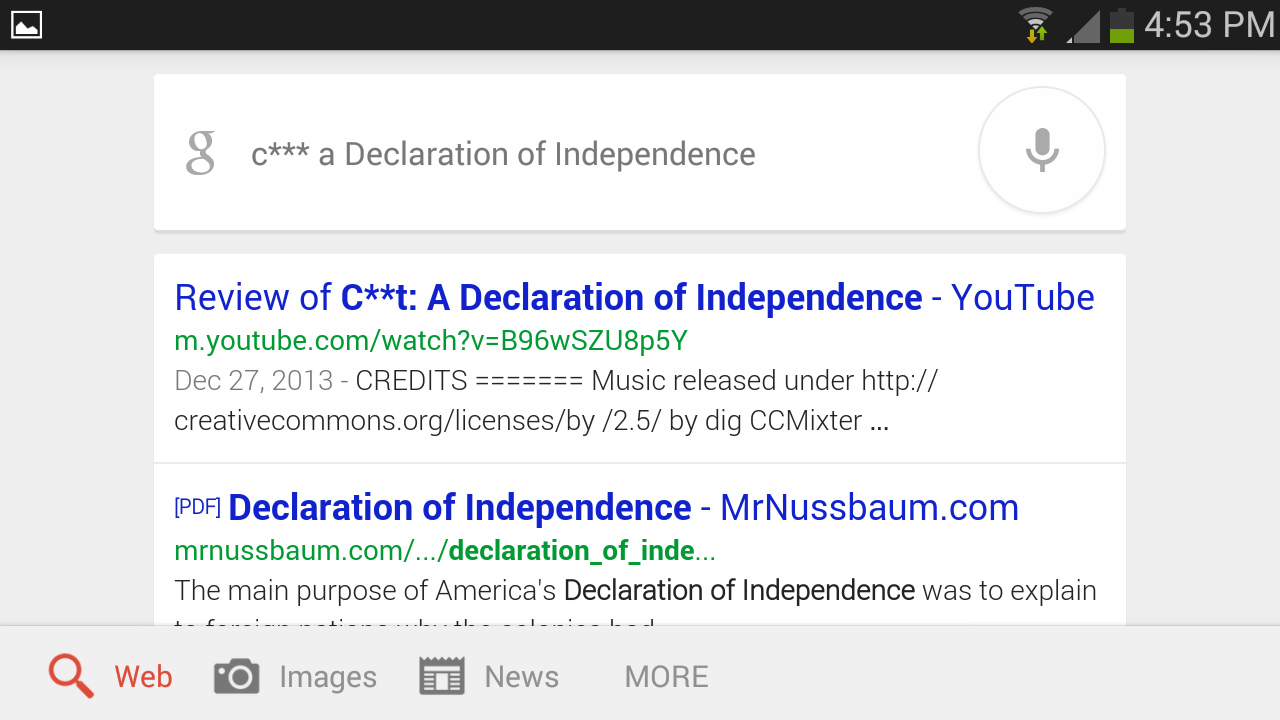
The five-letter p-word and four-letter c-word for female genitalia are understandably verboten, as is the four-letter c-word for male genitalia (and for "rooster").
pussy riotedit
cu t decleration
co k henhous
Oddly, Google tolerates plenty of common (and crude) anatomical terms, including the four-letter d-word for male genitalia (short for "Richard") and the five-letter b-word (rhymes with "loner" and can also mean "blunder") for the same body part in its erect state.
The four-letter t-word referring to female genitalia (rhymes with "swat"), which most people consider vulgar, goes uncensored by Google: The search app's robo-voice automatically reads the word aloud, along with its definition (simply "a woman's genitals").

Sexual acts

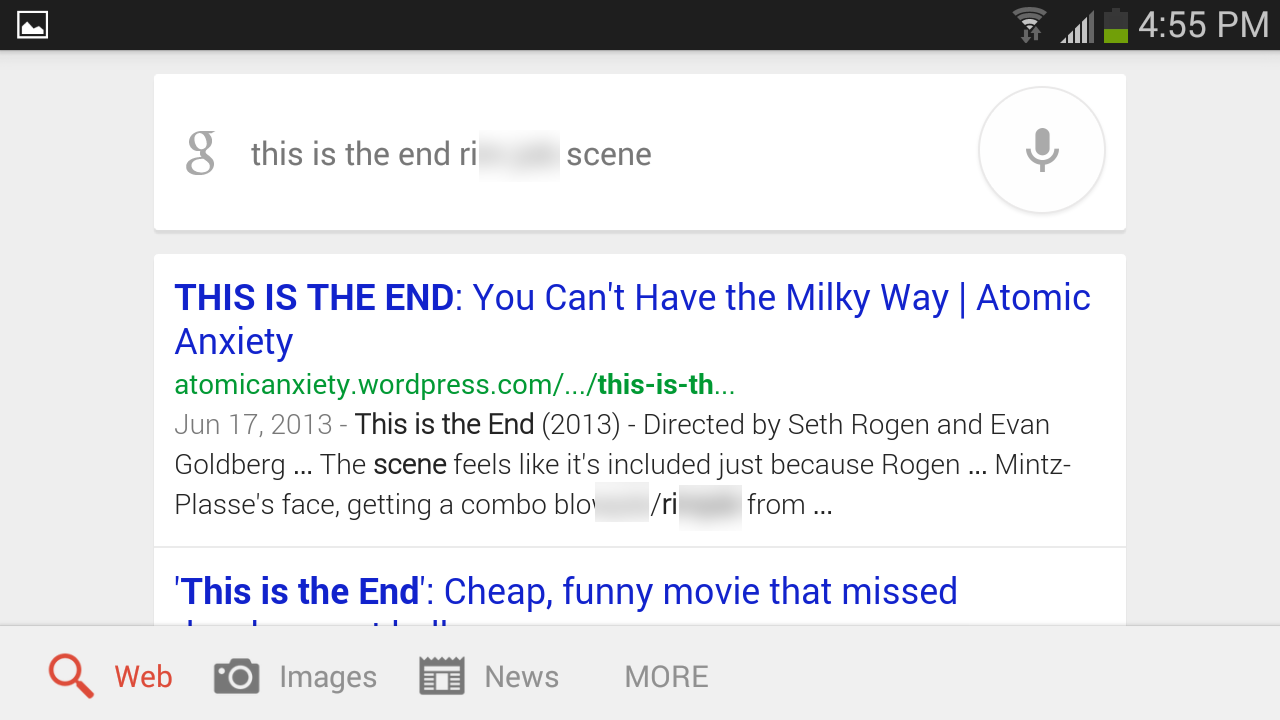
When it comes to acts of recreational sex, Google's criteria for what terms are acceptable seem arbitrary and strange. Predictably the common seven-letter b-word for "fellatio" that ends with job gets the asterisk treatment.
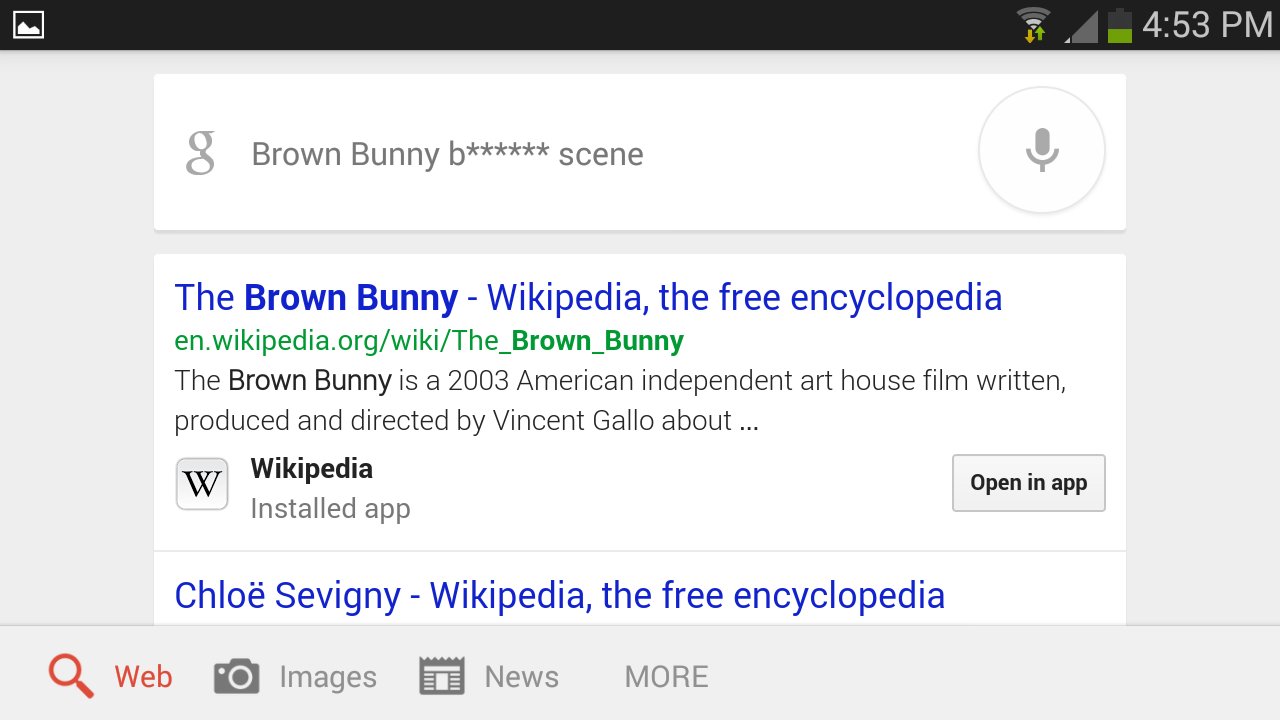
blo  ob bunny
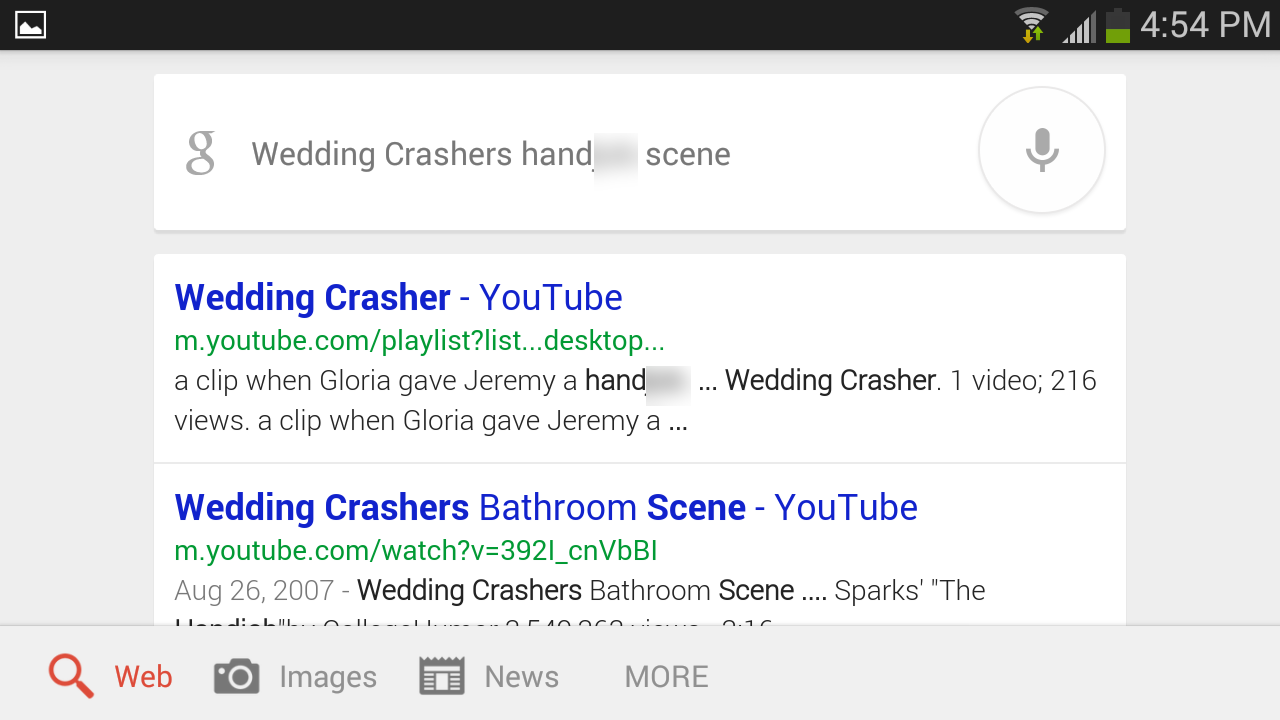
However, the terms for sexual acts that have the same ending but begin with hand or rim apparently didn't raise any red flags for Google.
han  obweddingcrashedit
ri  obtheendedit
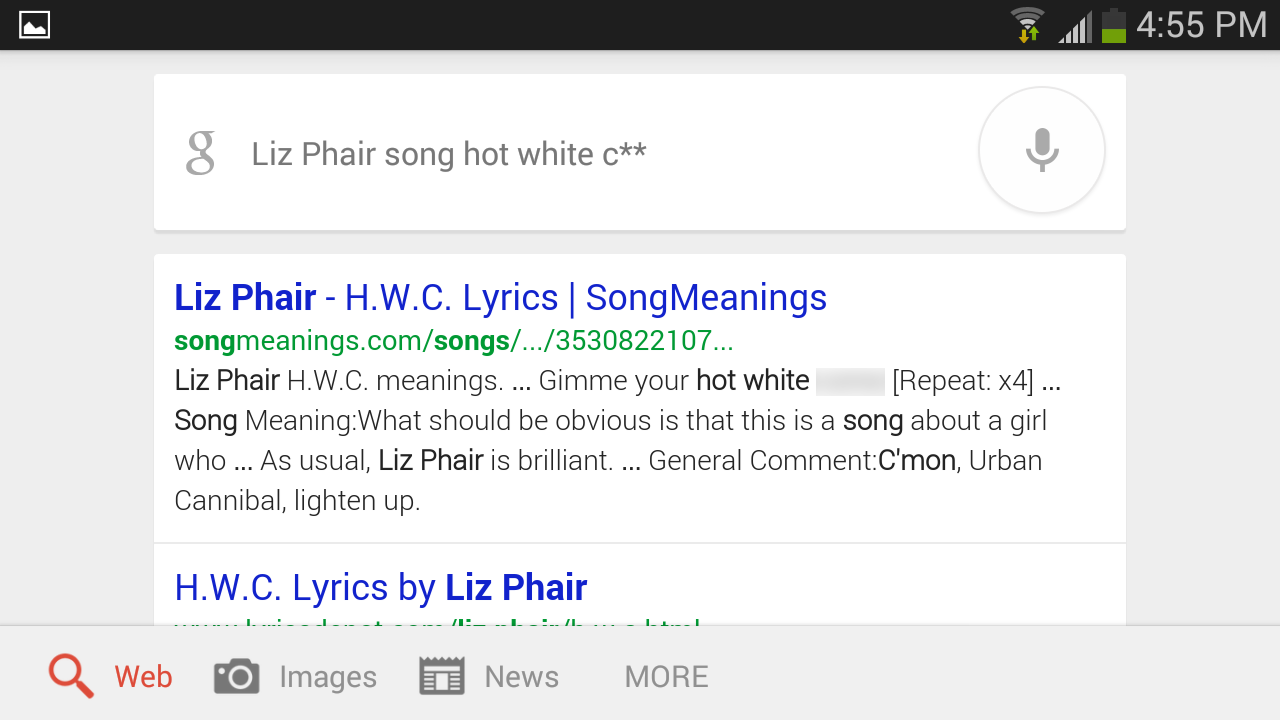
The three-letter c-word referring to "orgasm" or "ejaculate" is out, though the similarly used four-letter j-word (the one that's a single letter off from "jazz") gets through without hindrance.
cu liz phair edit
The terms for male masturbation beginning with jack or jerk find clear sailing, as do various terms for female stimulation that begin with the word finger. An array of less common words for various creative (or procreative) sexual activities also made the Google cut, as interested parties can discover for themselves.

Hate speech

Google search declines to recognize the six-letter n-word. It also blocks the more casual five-letter version of the word that ends in an "a" (and often appears in song lyrics).nig er nas
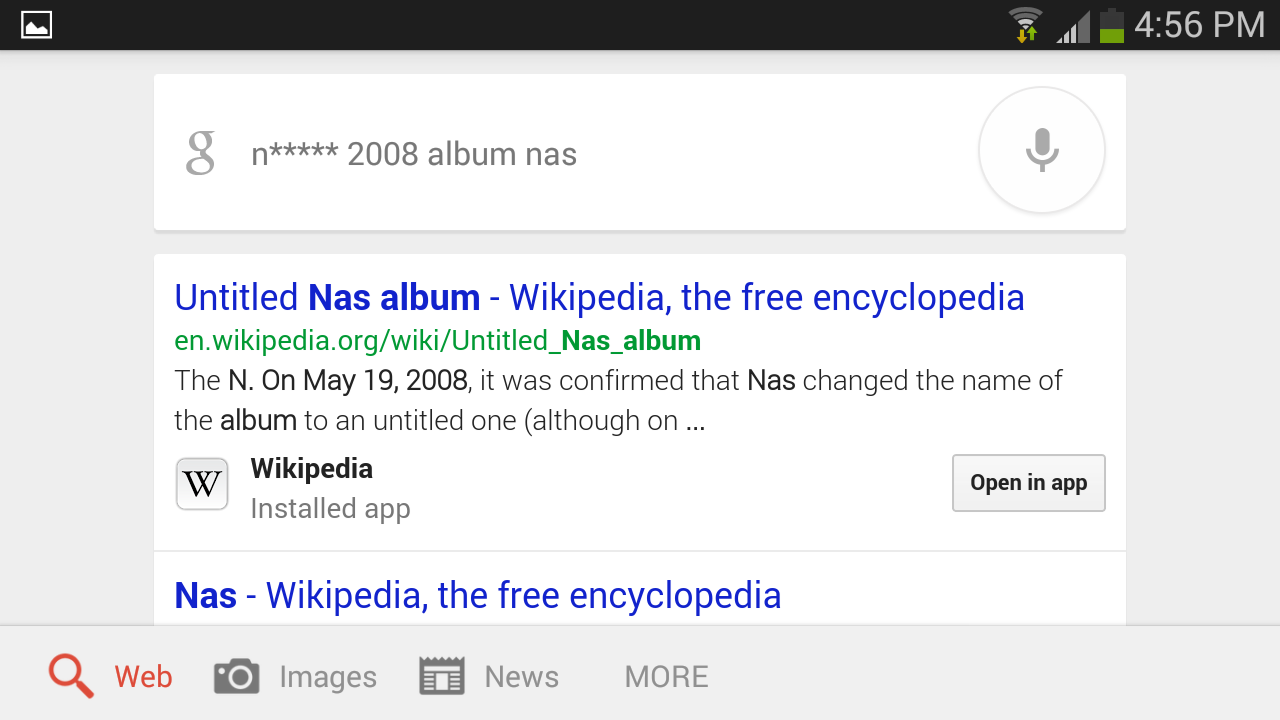
nwa edit
The seven-letter w-word aimed at Hispanics also gets censored. The common four-letter s-word slur is probably also forbidden, but I couldn't get my phone to recognize it at all.
we  ackdonyoungedit
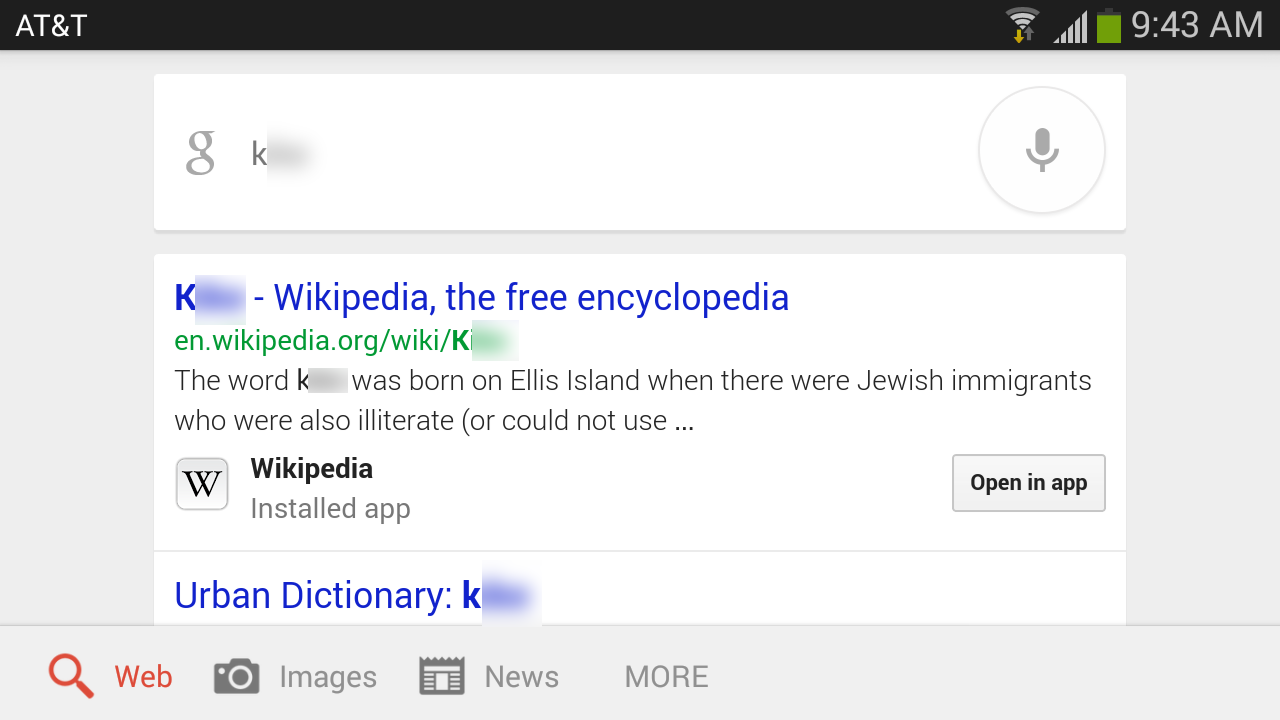
The four-letter k-word slur for Jews is not blocked. Maybe that term has fallen out of favor among anti-Semites. As a Web-enabled person of Jewish descent, I'm subjected to occasional doses of anonymous venom, but that word has never come up.
k ke edit
How commonly used a slur is seems to be a key factor in Google's censoring decisions. In the post-9/11 United States, we've seen a rise in hateful language aimed at people thought to be of Middle Eastern descent. Perhaps in response to that trend, Google search refuses to countenance the seven-letter r-word and the nine-letter t-word that begin with rag and towel and are used as ethnic slurs.
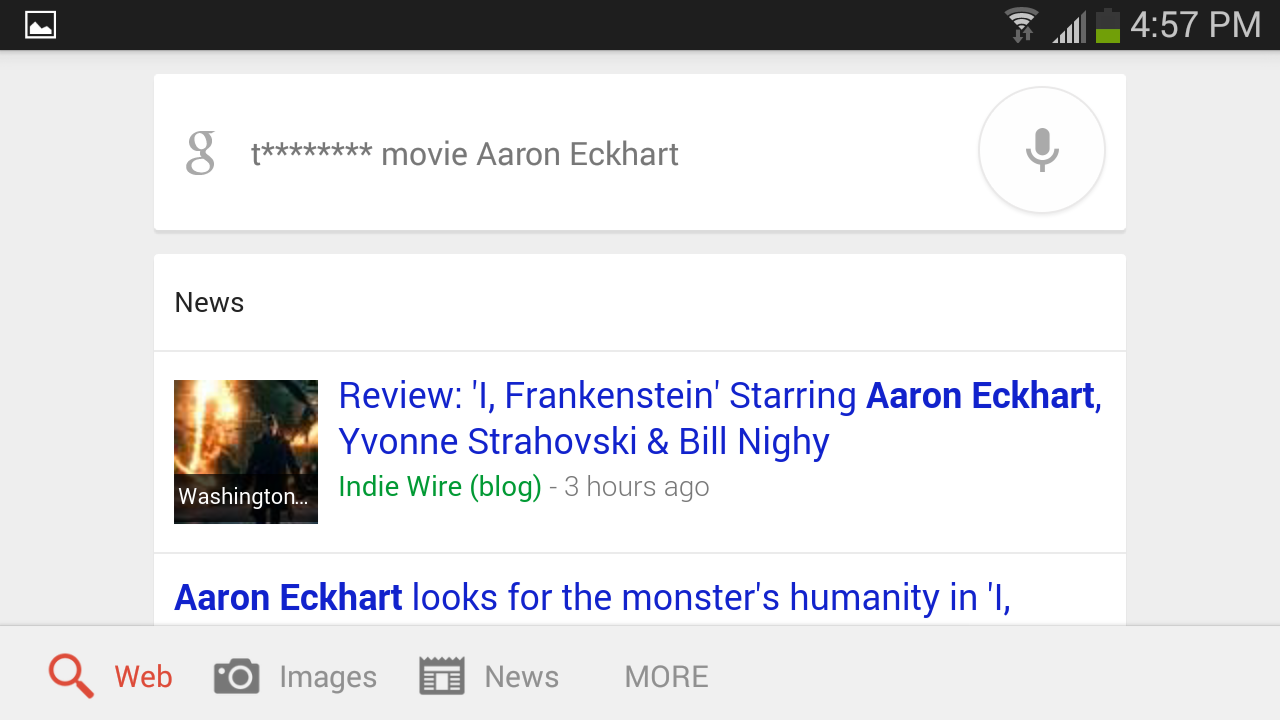
One unintended side effect of this policy is to prevent users from directly voice-searching the excellent coming-of-age film Towelhead starring Aaron Eckhart, or the novel it was based on. A search for "t******** movie" will not return the film on the first page of results, the algorithm recognizes it as the nonsense search "t movie."

ragh  d colter
tow  head aaron
The six-letter f-word used a slur for a gay men is censored, and I assume that the shortened, three-letter version of that word is blocked too, though I couldn't get my phone to recognize it. Likewise, the ten-letter c-word (whose last six letters rhyme with "trucker"), used as a homophobic slur, is blocked.
fa  oteminiemedit
co  suckerdeadwood
The four-letter d-word referring to gay women doesn't get censored—perhaps because the term (in British English, anyway, it's commonly spelled with a "y") also has nonhateful meanings ("ditch" and "levee"). Or perhaps the word has been appropriated by the lesbian community as a prideful way to refer to themselves.
dy emarchedit
Google does seem to look askance at misogyny, blocking the five-letter w-word for "prostitute" as well as the five-letter b-word for "female dog."
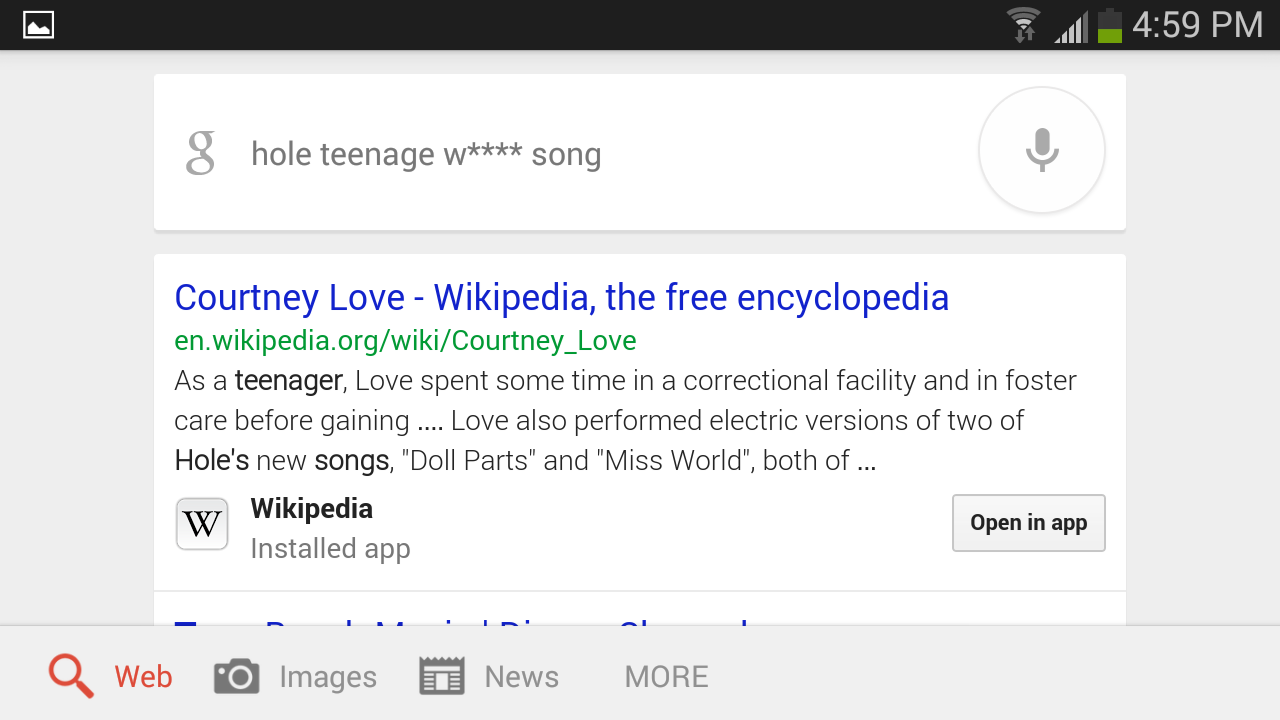
wh reholesong
bi tchmeredithbrooksedit
Many other common slurs seem not to have prompted Google to ban them, but we see no reason to mention them all here; just use your imagination.
Though we reached out to Google to ask how it decides which content to block in voice search, we have yet to receive a response. 
People have tried to define and quarantine naughty content since time immemorial, and such efforts (and the debates they spawn) often prove to be messy and contentious. As it turns out, Google—a multinational corporation with near-unlimited resources—is just as confused as everyone else.

2 comments:

Facebook uses 10,000 Blu-ray discs to store 'cold' data


If you thought Netflix and iTunes would make optical discs a thing of the past, think again. Facebook has built a storage system from 10,000 Blu-ray discs that holds a petabyte of data and is highly energy-efficient, the company said Tuesday.
Facebook said last year that it was exploring Blu-ray for its data-center storage needs, and on Tuesday it showed a prototype system at the Open Compute Project summit meeting in San Jose, California.
It designed the system to store data that hardly ever needs to be accessed, or for so-called “cold storage.” That includes duplicates of its users’ photos and videos that Facebook keeps for backup purposes, and which it essentially wants to file away and forget.
The Blu-ray system reduces costs by 50 percent and energy use by 80 percent compared with its current cold-storage system, which uses hard disk drives, said Jay Parikh, Facebook’s vice president of infrastructure engineering, in a talk at the Open Compute summit.
The company expects to be able to increase the capacity of the system to five petabytes over time, he said.
Blu-ray discs are a good option for cold storage because they cost less to buy than hard disks and there’s a lot of room for manufacturers to increase the storage density of Blu-ray, said Jason Taylor, Facebook’s director of infrastructure, in an interview.
If the idea takes off, it might extend the life of the optical disc industry.
“We see this as a new area of demand for the technology,” Taylor said.
The machine Facebook built is still a prototype, but it expects to start production tests later this year, he said.
Blu-ray is one option for Facebook’s cold storage, but eventually it hopes to move to a low-power version of flash, Taylor said.
Parikh showed the system on stage at the Open Compute summit. Outside it looks like a plain server cabinet, about 7 feet tall, but inside there’s all kinds of robotic wizardry to move the discs around.
The discs are stacked in piles, and a robotic picker can quickly select a disc from a pile and move it to one of 16 burners in the system, which write data to the discs.
Facebook is still deciding which parts of the design it will submit to Open Compute Project, Taylor said.
The social network set up the Open Compute Project about three years ago as a way for it to collaborate with peers to develop hardware that better suits their needs.
On Tuesday, several companies announced technologies they will contribute to the project, including Advanced Micro Devices, Seagate, Quanta and LSI. On Monday, Microsoft said it would contribute some of its cloud server designs.

0 comments:

Obama touches on NSA reform in State of the Union address


U.S. President Barack Obama repeated his call to reform intelligence surveillance programs, saying U.S. intelligence agencies need the trust of people inside and outside the country, during his State of the Union speech Tuesday night.
Obama promised to work with the U.S. Congress to reform surveillance programs, presumably those at the U.S. National Security Agency exposed in the past eight months by leaker Edward Snowden. “The vital work of our intelligence community depends on public confidence here and aboard, that privacy of ordinary people is not being violated,” Obama said.
The president’s remarks on surveillance reform were brief, but seemed to track with his call last week to reform NSA programs.
Obama also addressed a handful of other issues related to the tech industry. He called for patent reform, saying Congress needs to allow U.S. businesses to innovate instead of facing “costly and needless” patent lawsuits. Many lawmakers have pushed for legislation that would make it more difficult for so-called patent-assertion entities, firms that have patent lawsuits as their primary business models, to sue other businesses.
Michael Beckerman, president and CEO of trade group The Internet Association, applauded Obama’s call for patent reform. “The days of patent trolls ... terrorizing innovative and hard-working businesses are numbered,” he said by email. “American businesses large and small are cheering the president’s call tonight. Abuse of the broken patent system by patent trolls hurt main street businesses, as well as the Internet industry.”
Obama also called on Congress to pass immigration reform. Many large technology companies have called for more high-skill immigration visas, but Obama’s remarks focused largely on illegal immigration issues.
Obama also praised the U.S. Federal Communications Commission, Apple, Microsoft, Sprint and Verizon Communications for pushing for higher speeds of broadband in the nation’s schools. The companies will help to connect more than 15,000 schools to faster broadband within two years, he said.
FCC Chairman Tom Wheeler said the agency’s E-Rate program bring better broadband to schools.
“Harnessing the power of digital technology is central to improving our education system and our global competitiveness,” he said in a statement. “In the Internet age, every student in America should have access to state-of-the-art educational tools, which are increasingly interactive, individualized and bandwidth-intensive.”

0 comments:

Adobe looks poised to release Lightroom for mobile devices


Lightroom 5.3


Adobe appears to be getting closer to releasing a version of Lightroom for mobile devices.
(Credit: Screenshot by Stephen Shankland/CNET)
Adobe Systems this week tipped its hand when it comes to the future of its Lightroom, revealing on its Web site a subscription plan for a mobile version of the software for editing and cataloging photos.
9to5 Mac spotted the subscription, a package costing $99 per year called "Adobe Lightroom for mobile."
It's not clear exactly what the package would include, but an iPad version seems likely. Adobe showed a prototype of Lightroom-style photo editing for the iPad in 2013. That software used a cloud-computing service to keep photo changes synchronized with a Lightroom catalog hosted on a personal computer.

Adobe took down the Lightroom mobile option when 9to5 Mac contacted the company about it.Last year's software demo included editing controls for exposure, contrast, highlights, shadows, vibrance, clarity, temperature, tint, sharpen, luminance noise reduction, color noise reduction, whites, blacks, auto tone, and auto white balance. Buttons across the top of the app included options for flipping and cropping photos.
Adobe declined to comment on its plans: "Last year Adobe did a sneak peak on bringing certain Lightroom capabilities to mobile platforms, however we have not made any formal announcement about official plans and have no further details to discuss about Lightroom at this time," spokeswoman Marissa Lee said.
It's possible there could be other charges for the software. Adobe has moved aggressively to its Creative Cloud subscription, the high end of which costs $50 a month and grants access to any Adobe software -- except its mobile apps. Initially, Adobe had planned to include the mobile apps in the subscription, but app-store rules preclude that option, so for now the mobile apps cost money.
It's also not clear how the subscription will dovetail with a $10-per-month Photoshop Photography Program, which grants access to Lightroom, Photoshop, and 20GB of cloud-based file storage. That subscription is available for a limited time, though Adobe already extended its availability twice. The current deadline for signing up is February 28; only customers who purchased Photoshop CS3 or later are eligible.

0 comments:

Jimmy Wales joins The People's Operator, looks to US launch


LONDON -- Wikipedia founder Jimmy Wales is joining The People's Operator, a UK-based mobile provider focused on raising money for charity, as co-chairman. The company plans to expand to more countries, with the US first on its list.
"I get a lot of pitches for a lot of things, which fall into two camps: they're either well meaning but unworkable, or workable but not that inspiring," Wales told CNET in a phone interview today. "[TPO] has the potential to raise an enormous amount of money for good causes, and I can see how it works."
TPO is an MVNO, or mobile virtual network operator, meaning it buys bulk capacity from network operators and sells it on to consumers. Launched in the UK in 2012, its USP is that it passes on 10 per cent of your phone bill to a charity of your choice, and donates 25 per cent of company profits to charity too.
Wales met TPO's founder and other co-chair Andrew Rosenfeld socially in London, and will talk about his new role at the DLD14 conferencein Munich today. Part of his job will be to take meetings "at the highest level" with major charities, to encourage them to promote TPO and for users to nominate them as their chosen causes. He will also oversee development of software to build an online community around the company.
"Our plan is to open in as many countries as we possibly can," Wales says. "We'll start that process in the coming year. It won't happen [in the US] overnight, but as rapidly as we possibly can." Wales wouldn't name potential MVNO partners and investors, with talks still at an early stage.
The new role won't impact his work at Wikipedia, Wales promises. "I'm very active in the community of Wikipedia, I edit it almost every day, and I'm a very active board member. It's been my part-time work and hobby for many years -- I might have to cut out some travel, which my wife will be happy about."
But what happened to his handsome mugshot asking for our money? "There's a really ugly yellow banner that performs incredibly well. We might use my picture again, but it would have to perform as well as that," he explained.

0 comments:

DNA solves one of the Titanic's oldest mysteries


DNA has helped solved a nearly 70-year-old hoax -- one that has haunted a family and its ancestors in the debacle over the identity of a girl who was said to have died on the Titanic.
When the massive ship struck an iceberg more than 100 years ago, it was believed that only one child from the first class died in the sinking ship: Loraine Allison. The 2-year-old apparently didn't get safely on a life boat because her parents were said to have been frantically searching for her little brother, who unbeknownst to them was already on a life boat. Allison and her mother's body were never found in the ship's wreckage.
In 1940, 28 years after the Titanic went down, a woman named Helen Kramer appeared on a radio show claiming that she was Loraine Allison. She had an intricate story of being saved by the ship's designer and builder Thomas Andrews, who was also thought to have died on board. Kramer said she was raised in England before going to boarding school in the US.
For more than 50 years, Kramer adamantly lobbied the wealthy Allison family trying to prove that she was kin. But, for the most part, the family was skeptical of Kramer's claims and held her at arm's length.

A group of Titanic enthusiasts created the Loraine Allison Identification Project and persuaded a member of the Allison family and a relative of Kramer's to get DNA tested, according to
 The Telegraph. The results conclusively show there is no genetic relation between the two groups.When Kramer died in 1992, her granddaughter Debrina Woods picked up where she left off. Woods continued to try to convince the Allison family that she was a descendant of Loraine Allison claiming she had a suitcase of documents to prove it. Now, after more than 70 years, the family knows the truth.
"It is good to have a resolution here, but we mustn't forget that this is all about one of the more tragic of tales to come from the Titanic," Loraine Allison Identification Project founder Tracy Oost told The Telegraph. "The only mystery that remains now is who was Helen Kramer."

0 comments:

India to launch Chandrayaan-II by 2017

Chandrayaan-II is a mission where we essentially need to move on (lunar) surface to conduct experiments. We will launch Chandrayaan-II with an indigenous rover and lander using GSLV by 2016 or 2017," Space Secretary K Radhakrishnan said at a press conference here.

Chandrayaan-I, India's first mission to Moon, was launched successfully on October 22, 2008 from Sriharikota. The spacecraft was orbiting around the Moon at a height of 100 km from the lunar surface for chemical, mineralogical and photo-geologic mapping of the Moon.

Talking about Chandrayaan-II, Radhakrishnan said a study was done to check if an indigenous lander and rover could be developed which gave a positive feedback after which the ISRO decided to go ahead with the project.

"In May 2012, we conducted a feasibility study on development of a lander and this has been completed. We find that we will be able to develop a lander in India. We need 2-3 years time," he said.

Radhakrishnan, however, added that there were a few technological elements in a lander which need to be developed.

"First, we need to reduce the velocity of a lander as it comes for soft landing. Second, to develop the mechanism that is involved in a lander. Third, is to locate precisely where to land by taking pictures and then steering the lander to a place it has to land," he said.

0 comments:

Three things Samsung learned from Galaxy Gear version No. 1


The Samsung Galaxy Gear smartwatch
(Credit: Andrew Hoyle/CNET) LAS VEGAS -- Samsung's first attempt at the wearables market hasn't gone so well, but it has learned some important lessons for the next time around, executives tell CNET. In September, the Korean consumer electronics giant unveiled the Galaxy Gear, a smartwatch that connects to a user's smartphone or tablet to provide alerts, take photos, make calls, and access certain apps. Samsung might have beaten Apple to the wearables market, but the early response has been tepid.

Wearable tech: What's new and cool right now (pictures)

1-2 of 13
Scroll Left Scroll Right
Tech reviewers, including CNET, have criticized Gear for its high price tag, weak battery life, wonky voice command feature, and limited compatibility with other devices. And it's unclear just how many devices the company has sold. The belief is that return rates are high, though Ryan Bidan, director of product marketing for Samsung's US mobile business, said there aren't more returns than for other Samsung devices. The company believes the segment can become a huge business, and it's already working on future devices. That includes at least one sleeker smartwatch with a higher-quality screen that's slated for a March release, according to people familiar with the matter.
"Headquarters really understands what's going to drive further consumer adoption," Samsung's Curtis Sasaki told CNET, though he declined to provide specific details. [You can see CNET's thoughts here]. He oversees the head of Samsung Media Solutions Center America, the company's software and services business based in Silicon Valley.
"We know what we need to do," Sasaki said.
Here are three major insights Samsung has gleaned from the Galaxy Gear, according to Bidan: People want to see more information on the smartwatch
One big insight is that consumers actually want to do more on Gear itself, rather than constantly reaching for their phones. The first version of the device alerted people if they had an e-mail but didn't let them read that message. A recent software update changed that, allowing users to see who had contacted them, as well as read the first paragraph or so of the message.
People want to talk to Gear more
Rather than using the touch screen to control the smartwatch, people want to do more using voice control.
Make a replaceable band
Gear comes with several color options for the band, but once a user has chosen, they're stuck with their option. A big reason for that is the camera built into the band. However, many people have asked that Samsung make the band switchable, Bidan said.
These are just a few of the things Samsung has learned from the many studies and surveys it has done from its first attempt in wearables. There's no guarantee it will actually implement these, but there's a good chance. We'll see what happens with Gear 2 (and 3 and 4 and so on).

0 comments:

India’s fastest internet speed to be 50% slower than global highest

NEW DELHI: India is eagerly awaiting the launch of Reliance Jio's 4G connection, which promises to offer average internet speed of 49Mbps on the go. This is over 12 times faster than the current average of 4Mbps on the country's 3G networks. In theory, Reliance Jio's 4G network will offer maximum speed of 112Mbps. 

Download speed of 49Mbps may seem astounding for those in India; however, the country will still lag far behind the leaders in the global internet race. 

When Reliance finally rolls out its 4G network, it will still be nearly 30% slower than the UK-based service provider EE's highest download speed of 300Mbps, the maximum internet speed on a mobile network in the world. EE promises average speed of 25-30Mbps across the UK, with speeds as high as 60Mbps in certain cities. 

According to latest data compiled by analytics website Speedtest.net, the US town of Ephrata, Washington DC enjoys average internet speed of 85.54Mbps. However, the national average internet speed of the US is 18.5Mbps. On mobile networks, the maximum speed in the country is 58.25Mbps (AT&T 4G, according to data by PCMag). 

Google Fiber, the internet titan's pilot internet project, promises maximum speed of 1Gbps (gigabits per second; 1gigabit = 1024megabits) in the US. However, actual speed delivered in Kansas City under this project is 49.86Mbps, the second highest in US according to Speedtest.net data. 

South Korea, widely acknowledged as the most 'connected' nation in the world, has highest broadband internet speed of 53.3Mbps and average speed of 13.3Mbps, according to Akamai. On mobile networks, telecom operator SK Telecom in November claimed that it has achieved maximum internet download speed of 225Mbps on its LTE-Advanced (LTE-A) network. LTE-A is a new technology that allows 50% faster data download over mobile networks. 

The speed of 225Mbps has been achieved for a demo, while the commercial rollout of the service will be done in the second half of 2014, around the same time when Reliance rolls out its 4G network. This will, in effect, render Reliance's network nearly obsolete in the global race. SK Telecom also plans to offer download speed of 300Mbps on mobile connections, though it has not given a time frame for this. 

In Hong Kong too, it's a similar story, with peak speed of 65.1Mbps (the highest in the world) and average speed of 10.8Mbps. The average 4G mobile download speed in the country, according to Akamai, is 20Mbps. 

Akamai's data dates back to the July-September quarter, and it is likely that the internet speeds may increase in by the time Reliance's network rolls out. 

Another network operator offering 4G in India is Bharti Airtel. The company's network is currently available in cities like Pune, Kolkata and Bangalore and is not available on mobile phones. It offers average download speed of 40Mbps via USB dongles, with theoretical highest speed of 100Mbps. 

Thus, it is easy to see that India's fastest consumer internet network will not stand anywhere close to that of mature markets and will even remain far behind upcoming networks in terms of pure download speeds. 

Also, the 3G flopshow in India, where only 107 million users (out of an estimated 919 million) use 3G internet on mobile devices, does not bode too well for Reliance's soon-to-be-rolled-out 4G internet. Pricing has been one of the major hindrances for the penetration of 3G, along with patchy network. Thus, Reliance would not only have to maintain a reliable network for its 4G users, but will have to also regulate pricing to promote mass adoption.

With India's growing smartphone market, many a users are likely to spend on high-speed internet on mobile devices for a better user experience, especially since video viewing is expected to be the next big data consumption medium in the country.

0 comments:


Amazon teams with Samsung, studios on ultra high-definition TV

LAS VEGAS Tue Jan 7, 2014 5:33am IST
A women looks at the world's first curved UHD TV 55'' 4K screen at the booth of Samsung during a media preview day at the IFA consumer electronics fair in Berlin, September 5, 2013. REUTERS/Fabrizio Bensch/Files
A women looks at the world's first curved UHD TV 55'' 4K screen at the booth of Samsung during a media preview day at the IFA consumer electronics fair in Berlin, September 5, 2013.
CREDIT: REUTERS/FABRIZIO BENSCH/FILES

STOCKS

 
Amazon.com Inc
AMZN.O
$393.63
-2.81-0.71%
01/06/2014
 
Samsung Electronics Co Ltd
005930.KS
₩1,304,000.00
-3,000.00-0.23%
01/07/2014
 
Lions Gate Entertainment Corp
LGF.N
$30.91
+0.46+1.51%
20:40:00 IDT
(Reuters) - Amazon.com Inc (AMZN.O) is teaming up with Samsung Electronics Co Ltd (005930.KS) and major media corporations including Warner Bros and Lionsgate (LGF.N) to popularize "4K" ultra high-definition television.
Amazon, whose Instant Video service serves up thousands of movies and TV programs in direct competition with Neflix Inc (NFLX.O), did not outline specifics on their collaboration in a Monday announcement.
But Samsung and other consumer electronics makers are hoping that 4K TV - so-called because they are said to offer four times the resolution of conventional high-definition images - will take off as a format and recharge sales.
At the Consumer Electronics Show in Las Vegas, the South Korean tech giant said in a separate statement it also will work with other content distributors, including Netflix and cable operators Comcast (CMCSA.O) and DirecTV (DTV.O), on promoting 4K TV.
Amazon, for its part, has been investing heavily in digital media, hoping to draw traffic and drive new sales as consumers increasingly spurn traditional TV offerings in favor of on-demand content.
Ultra high-def TV has been slow to take off, partly because of the high cost of the new-fangled displays and insufficient content. High-definition television took years to become mainstream, after TV prices came down and content became more widely available.
Netflix has said the second season of its popular political drama "House of Cards" was shot and will be available in ultra high-def, becoming one of the first major TV series to take advantage of the technology.
"There are a number of elements that need to work together to create a true 4K experience for customers," Bill Carr, Amazon vice president of digital video and music, said in a statement.
"You need great content and compatible devices, but you also need a service that can deliver that content to your devices so that it plays beautifully."
In Monday's announcement, Amazon also named 20th Century Fox (FOXA.O) and Discovery (DISCA.O) among its media partners. It added that it will film all original series slated for 2014 in 4K ultra high-def. (Editing by Ken Wills)

0 comments:

More than 1 billion Android devices to ship in 2014 - Gartner


More than 1 billion Android devices to ship in 2014 - Gartner


STOCKS
A customer tries the Samsung Galaxy Note smartphone at a store in Seoul August 26, 2012. REUTERS/Lee Jae-Won/Files
A customer tries the Samsung Galaxy Note smartphone at a store in Seoul August 26, 2012.
CREDIT: REUTERS/LEE JAE-WON/FILES
 
Google Inc
GOOG.O
$1,117.32
+12.32+1.11%
01/06/2014
 
Samsung Electronics Co Ltd
005930.KS
₩1,304,000.00
-3,000.00-0.23%
01/07/2014
 
HTC Corp
2498.TW
NT$131.00
-2.50-1.87%
01/07/2014
(Reuters) - The number of smartphones and tablet computers shipped with Google's (GOOG.O) Android operating system will break the 1 billion barrier this year, research group Gartner said on Tuesday.
Android, which is installed on products made by Samsung (005930.KS), HTC (2498.TW), Sony (6758.T) and many other manufacturers, is forecast to reach 1.1 billion users in 2014, up 26 percent on last year, with the strongest demand in emerging markets.
Apple's (AAPL.O) iOS and Mac OS operating systems are expected to be in 344 million new iPhones, iPads and Macs this year, Gartner added, representing a 28 percent jump on the number of devices shipped in 2013.
"There is no doubt that there is a volume-versus-value equation, with Android users purchasing lower-cost devices compared to Apple users," Gartner analyst Annette Zimmerman said in a statement on Tuesday.
Microsoft's (MSFT.O) Windows operating system, which dominates the PC and notebook segments, is forecast to be in 360 million new devices, up from 328 million in 2013.
Growth in the PC and notebook segment has been hit by the popularity of tablet computers, sales of which are forecast to increase by 47 percent this year to 263 million, according to Gartner.
"Users continue to move away from the traditional PC as it becomes more of a shared-content creation tool, while the greater flexibility of tablets, hybrids and lighter notebooks address users' increasingly different usage demands," Gartner research director Ranjit Atwal said.
Sales of mobile phones are expected to continue to increase, but at a slower pace, with the focus moving away from top-end premium devices to mid-level products, he added.
Gartner said it expects combined global shipments of all devices to reach 2.48 billion units this year, up 7.6 per cent on 2013.
(Reporting by Paul Sandle; Editing by David Goodman)

0 comments: